

Turning Elephant and Rhino Dung into Paper
Innovation often begins with finding value in things that people usually discard.
In Assam, a father-daughter duo is demonstrating this through an unusual paper-making technique that transforms elephant and rhinoceros dung into handcrafted paper products.
The innovation comes from Elrhino, a sustainable enterprise founded in 2014 by retired mining engineer Mahesh Chandra Bora and his daughter, Nisha Bora.
Their venture uses natural plant fibres present in animal dung to create an alternative source of raw material for paper production.
The idea occurred to Mahesh after he read about a similar paper-making initiative in Rajasthan.
Since Assam has significant elephant populations and is home to the one-horned rhinoceros, he saw an opportunity to explore the concept locally.
Initially, Mahesh conducted experiments at home using simple household equipment. He discovered that elephants and rhinos consume large quantities of grass and vegetation.
Their digestive systems do not completely break down these plant fibres, leaving fibrous material in their dung. These fibres can subsequently be processed into handmade paper.
Elrhino follows a process that converts animal waste into usable paper. First, workers collect and clean the dung.
They then wash and boil it to remove impurities before processing the remaining fibres into pulp.
The pulp is combined with other materials, including recycled paper, cotton waste and plant fibres. Workers then press and dry the mixture to produce handmade paper sheets.
The finished material is used to manufacture notebooks, journals, paper bags, playing cards, lampshades and decorative products.
The venture also incorporates natural materials such as banana stem fibres into some of its products.
Beyond creating an unusual product, the process offers an alternative to conventional wood-based paper. It also encourages the productive use of waste materials.
Elrhino’s approach extends beyond sustainable manufacturing. The venture also aims to create livelihood opportunities for rural communities living near wildlife habitats.
Local villagers collect dung and supply it for processing, earning additional income from an otherwise discarded resource.
The initiative also provides opportunities for rural artisans to participate in handmade paper production and craftwork.
This approach creates an economic connection between local communities and wildlife conservation.
By generating value from animal waste, the venture encourages communities to recognise the potential benefits of protecting elephants and rhinos.
Through Elrhino, Mahesh and Nisha are combining traditional craftsmanship with resource innovation.
Their initiative demonstrates how an unconventional raw material can support sustainable products, rural livelihoods and greater awareness of wildlife conservation.
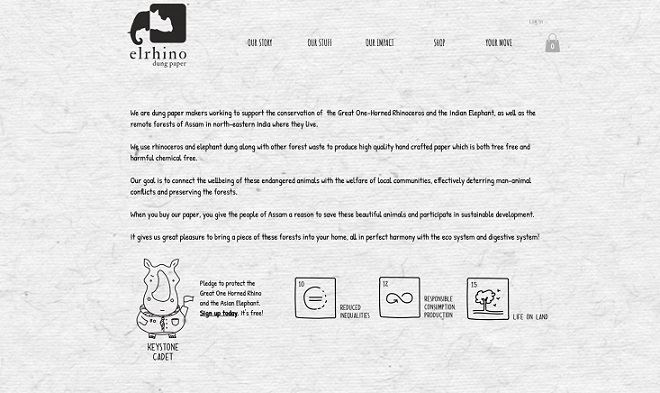
Image Credit: Elrhinopaper Website Screenshot
You may also like


Image Reference: https://www.elrhinopaper.com/
Recent Posts
- Turning Elephant and Rhino Dung into Paper
 Through Elrhino, Mahesh and Nisha are combining traditional craftsmanship with resource innovation.
- Delhi Turns Back 16,827 Polluting Vehicles
 Private cars accounted for the highest number of penalties during the nine-day period, attracting 382 challans.
- Gurugram Car Fireworks Stunt Goes ViralReckless driving continues to raise road safety concerns, with another dangerous stunt reported from Gurugram. A viral video shows youths setting off fireworks from a moving car on the Dwarka Expressway, risking the safety of other commuters.
WeRIndia – A News Aggregator

Visit werindia.com for all types of National | Business | World | Politics | Entertainment | Health related news and much more..
Leave a Reply