

Made-in-India Prosthetic Breakthrough
Innovation often begins with identifying what existing solutions fail to solve.
For Mumbai-based startup Robo Bionics, that challenge lay in making prosthetic hands more accessible, comfortable, and practical for everyday use.
India faces a significant gap in prosthetic care. While amputation remains a major cause of disability, access to advanced prosthetic devices remains limited due to high costs, complex rehabilitation requirements, and inadequate availability.
Existing robotic prosthetics are often bulky, expensive, and difficult to use independently.
Recognising these limitations, IIT Patna alumni Llewellyn D’sa and Priyanka D’sa developed a different approach. Their innovation focuses on simplifying both the technology and the user experience.
At the centre of this effort is Grippy, a lightweight, 3D-printed prosthetic hand designed for below-elbow amputees.
Unlike conventional myoelectric systems that rely on electrical muscle signals, Grippy uses proprietary Mechanomyography (MMG) technology. The system detects physical muscle pressure changes and converts them into hand movements.
This shift in sensing technology addresses a long-standing challenge in prosthetics. Traditional EMG-based devices often struggle with sweat, humidity, skin movement, and muscle fatigue.
MMG technology, however, remains functional under these conditions, making it more suitable for real-world environments, particularly in tropical countries like India.
The innovation extends beyond hardware. Grippy automatically adjusts grip strength based on the object being handled, reducing the risk of dropping or damaging items.
Built-in touch feedback further improves control while shortening the learning curve for users.
Robo Bionics has also introduced a training ecosystem around the device. Its BrawnBand wearable and gamified mobile application help users strengthen residual muscles before prosthetic fitting.
This digital rehabilitation model enables clinicians to monitor progress remotely and prepare patients for smoother adoption.
The company’s approach reflects a broader trend in healthcare innovation, combining robotics, digital training, and user-centric design into a single solution.
With international-quality certifications, clinical validation, and plans for global regulatory approvals,
Robo Bionics is demonstrating how indigenous engineering can address complex healthcare challenges while making advanced assistive technology more accessible and practical.
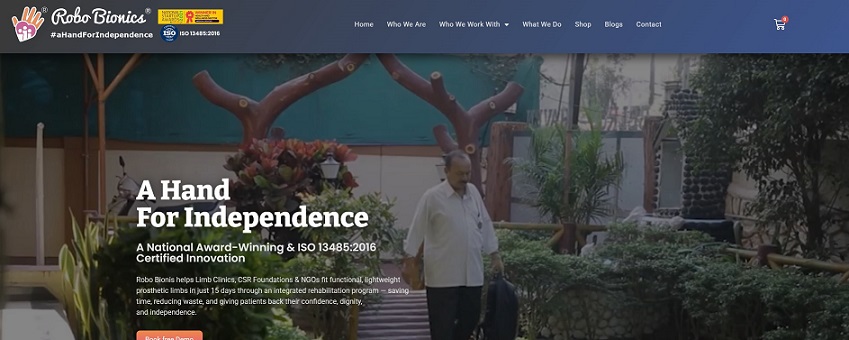
Image Credit: Robobionics Website Screenshot




Image Reference: https://robobionics.in/
Recent Posts
- Opposition Plans Supreme Court March Over ‘Vote Chori’ Row
 Earlier, leaders of several INDIA bloc parties had marched from Parliament to Vijay Chowk.
 - Indian Navy to Commission Mangrol, Boosting Coastal Defence
 Mangrol incorporates more than 80 per cent indigenous content.
 - Eden Gardens Sets Guinness World Record on MahalayaMahalaya celebrations at Kolkata’s Eden Gardens made history as 3,000 dhakis played the dhak together, setting a Guinness World Record. The grand event on October 10 marked the beginning of Devi Paksha and the countdown to Durga Puja.
WeRIndia – A News Aggregator

Visit werindia.com for all types of National | Business | World | Politics | Entertainment | Health related news and much more..