

Delhi’s Diwali Glow Fades Under a Thick Blanket of Toxic Smog
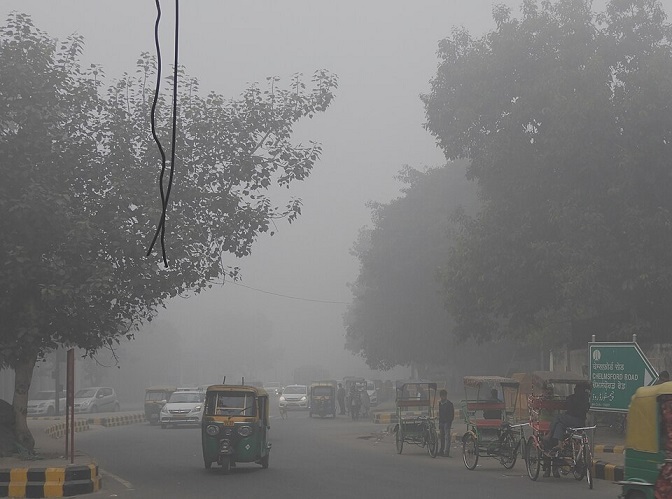
Festivals bring colour, joy and celebrations, but rising pollution can quickly overshadow their spirit.
Delhi witnessed this contrast during Diwali, as firecracker emissions worsened an already alarming air quality situation across the national capital.
The city’s average Air Quality Index (AQI) reached 371 at 7 pm on Sunday, compared with 369 on Saturday, according to the Central Pollution Control Board (CPCB).
Consequently, Delhi remained in the ‘very poor’ category, dangerously close to the ‘severe’ threshold of 401. Moreover, CPCB’s live dashboard recorded an AQI of 372 at 6 pm.
The situation was particularly concerning across several neighbourhoods.
Of the 59 monitoring stations reporting data, 20 recorded ‘severe’ pollution levels, while 31 remained in the ‘very poor’ category. Only eight stations reported ‘poor’ air quality.
Jahangirpuri emerged as Delhi’s most polluted location, with an AQI of 464.
Sonia Vihar followed at 448, while North Campus recorded 446. Similarly, Rohini and Burari Crossing reported readings of 444 and 443, respectively.
Meanwhile, thick haze and smog covered several parts of the city. Residents reported smoky conditions and reduced visibility as celebrations continued.
According to reports, firecracker emissions significantly increased particulate matter concentrations, with PM2.5 remaining the dominant pollutant.
However, firecrackers were not the only source of concern. Vehicle emissions, seasonal stubble burning in neighbouring states and unfavourable weather conditions also contributed to pollution.
Delhi’s Decision Support System estimated that transport accounted for 19% of the city’s pollution on Sunday. In comparison, stubble burning contributed around 3.5%.
The outlook for the coming days also remained worrying. The Air Quality Early Warning System forecast that Delhi could enter the ‘severe’ category from November 9 and remain there for several days. Low wind speeds and poor atmospheric ventilation could further restrict pollutant dispersion.
Under CPCB classifications, an AQI between 301 and 400 indicates ‘very poor’ air quality. Readings between 401 and 500 fall under the ‘severe’ category.
With pollution already approaching dangerous levels, Delhi faces another challenging period after Diwali.
The celebrations may have illuminated the city, but their aftermath has intensified concerns over its deteriorating air quality.
Image Credit: Sumita Roy Dutta, CC BY-SA 4.0, via Wikimedia Commons
You may also like


Image Reference:
https://commons.wikimedia.org/wiki/File:Low_visibility_due_to_Smog_in_entry_of_Chelmsford_Road_New_Delhi_31st_Dec_2017_9AM_DSCN8819_1.jpg

Recent Posts
- Delhi’s Diwali Glow Fades Under a Thick Blanket of Toxic Smog
 With pollution already approaching dangerous levels, Delhi faces another challenging period after Diwali.
- Maha FDA cracks down on Blinkit, Zepto; Suspends many licences
 Pune recorded the highest seizure, involving 14,429.7 kg of food products valued at ₹49.36 lakh.
- Ayodhya Glows with 30 Lakh Diyas at Grand DeepotsavAyodhya transformed into a spectacular sea of light as millions of earthen lamps illuminated the banks of the Sarayu during the tenth edition of Deepotsav. Blending spirituality, cultural heritage and modern technology, the grand celebrations brought the city alive with devotion, dazzling performances and a magnificent Ramayana-themed drone show.
WeRIndia – A News Aggregator

Visit werindia.com for all types of National | Business | World | Politics | Entertainment | Health related news and much more..
Leave a Reply