

Phool: Turning Temple Waste Into Opportunity
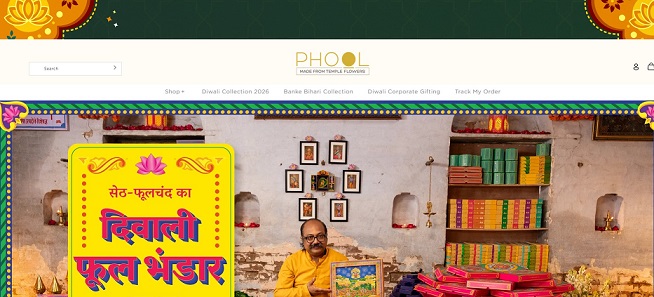
Every day, countless flowers are offered at temples across India. Once the rituals end, many of these flowers are discarded, creating a waste problem.
In Kanpur, startup Phool has built a business around giving these flowers a second life.
Founded in 2017 by Ankit Agarwal and Prateek Kumar, Phool emerged from Agarwal’s concern over seeing discarded temple flowers enter the Ganga.
Rather than viewing the flowers as useless waste, the founders explored how they could be collected, processed and turned into products.
That idea became the foundation of Phool’s business. The startup collects flowers from temples and upcycles them into products such as incense sticks, incense cones and wellness products.
Therefore, material that once had little commercial value becomes a raw material for a new product category.
The company’s work, however, goes beyond incense. Its research has resulted in Fleather, a flower-based biomaterial developed as an alternative to animal leather.
The product represents another attempt to turn organic waste into a usable material while exploring more sustainable alternatives for consumers and businesses.
Phool’s approach follows the principles of a circular economy. Instead of allowing discarded flowers to become waste, the startup brings them back into the production cycle.
The process begins with collection and moves through processing, product development and manufacturing.
The model also has a livelihood component. By creating work around flower collection and processing, Phool connects environmental management with income opportunities. As a result, its operations address more than one challenge at a time.
What makes Phool notable is the way it treats waste as a business opportunity. The startup has taken a material that is often overlooked and developed products around it.
At the same time, it has continued experimenting with new applications for flower waste.
From incense to innovative biomaterials, Phool demonstrates how entrepreneurship can find value in discarded resources.
Its journey also highlights a broader shift in business thinking: waste does not always have to be the end of a product’s journey.
With collection, innovation and the right processing methods, it can become the starting point for something new.
Image Credit: Phool Website Screenshot
You may also like




Image Reference: https://phool.co/
Recent Posts
- Model Chai Wali: Brewing Success, One Cup at a Time
 The ‘Model Chai Wali’ journey is about more than selling tea.
 - Kuruvapur: The Sacred Abode of Shripad Shrivallabha
 Kuruvapur attracts seekers who wish to deepen their devotion and experience spiritual tranquillity.
 - Opposition Plans Supreme Court March Over ‘Vote Chori’ Row
 Earlier, leaders of several INDIA bloc parties had marched from Parliament to Vijay Chowk.
WeRIndia – A News Aggregator

Visit werindia.com for all types of National | Business | World | Politics | Entertainment | Health related news and much more..
Leave a Reply