

Bihar’s Floating Home Turns Floods Into Innovation
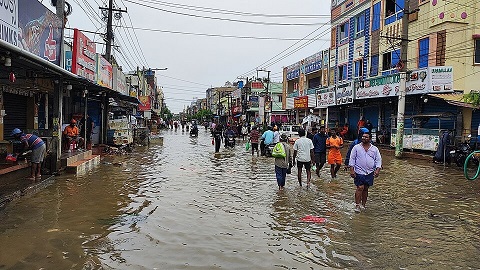
What if a house could rise with floodwaters instead of being destroyed by them?
That question led engineer and innovator Prashant Kumar to develop a climate-resilient floating home beside the Ganga in Bihar.
Designed specifically for flood-prone areas, the three-room structure is built to remain buoyant as water levels rise.
The house combines traditional knowledge with sustainable construction techniques.
Its design allows it to adapt to changing weather conditions rather than resist them through conventional flood barriers.
Innovation extends to almost every part of the structure. Kumar sourced construction materials from within a 10-kilometre radius.
This approach helped reduce transportation-related emissions and supported the use of locally available resources.
The house incorporates recycled pipes and eco-friendly bricks made using cow dung, lime, jaggery and rice.
Solar panels provide electricity, while a dry toilet system converts waste into compost. Green spaces around the home further strengthen its sustainable design.
The result is more than a floating structure. It is designed as a low-impact, self-sufficient home that can remain functional through Bihar’s changing seasons. It stays cool during summer and retains warmth during winter.
The project also demonstrates that climate-resilient construction does not necessarily require huge investments.
The house was built for around ₹6 lakh, showing how innovative design and local materials can make adaptation more affordable.
Kumar now wants to take the idea further. He aims to reduce the construction cost to nearly ₹1.5 lakh. That could make floating homes more accessible to communities repeatedly affected by floods.
His ultimate vision is a floating village in Bihar. Such a settlement could combine flood resilience, renewable energy, local materials and waste management in one model.
The innovation therefore lies not simply in making a house float.
It lies in rethinking how homes can respond to extreme weather while remaining affordable and sustainable.
Image Credit: Sripathroy, CC0 1.0, via Wikimedia Commons
You may also like




Image Reference:
https://commons.wikimedia.org/wiki/File:Flood_Water_on_Main_road.jpg

Recent Posts
- Everyday Habits That May Harm Your Brain Health
 Adequate sleep allows the brain to recover, process information and support memory.
 - Top 10 investment schemes in India that benefit from compounding
 A compound interest calculator can help estimate how investments may grow over time.
 - DGFT Hyderabad Recruitment 2026: Salary ₹60,000 Per Month
 The recruitment is for two Young Professional vacancies in Hyderabad, with a monthly remuneration of ₹60,000.
WeRIndia – A News Aggregator

Visit werindia.com for all types of National | Business | World | Politics | Entertainment | Health related news and much more..