

Metro Rail gets GST E-Way Bill facility, eases goods movement
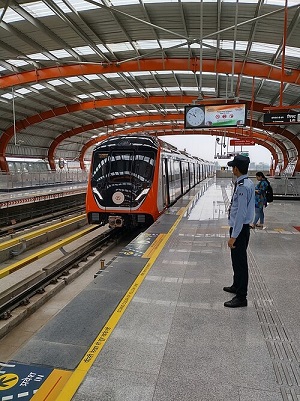
India’s expanding metro networks are creating new opportunities for businesses beyond passenger transportation.
In a significant move, the Goods and Services Tax Network (GSTN) has enabled traders to generate e-way bills for goods transported through metro rail services.
The change brings metro rail under the list of recognised transport modes in the GST system.
Accordingly, GSTN has amended Rule 138(2A) of the Central Goods and Services Tax (CGST) Rules. Metro rail now becomes the fifth transport option in Part B of the e-way bill.
Earlier, businesses could generate e-way bills for goods valued at ₹50,000 or above using road, rail, air and waterways.
However, metro transportation lacked a dedicated option. Since metro trains do not have conventional vehicle registration numbers, traders often faced difficulties documenting such movements.
Now, businesses can generate e-way bills directly through the GST portal. They can also update transportation details in bills created earlier.
Furthermore, traders moving goods through metro rail must enter the relevant transport document number instead of a vehicle registration number.
The facility is particularly useful for businesses handling valuable but lightweight products.
Jewellery shops, mobile retailers, electronics dealers and courier operators frequently transport expensive goods in bags or parcels.
Therefore, the new provision offers them a recognised way to document these transactions.
Previously, the absence of a suitable transport category could lead to questioning by tax enforcement teams. Officials could stop consignments or seek clarification about the transportation method.
With the revised provision, traders can maintain proper records and establish the legitimacy of goods movement more easily.
The facility also supports businesses in maintaining documentation for their input tax credit (ITC) claims.
Consequently, it can improve compliance and reduce disputes related to transportation records.
Meanwhile, businesses using ERP systems or direct API integration with GSTN can test the facility through the sandbox environment. However, the live API rollout date is yet to be announced.
The change addresses a practical gap in GST compliance.
It also brings metro-based goods transportation into the formal tax documentation framework, making movement between markets and customers more convenient.
Image Credit: Dr Vinamra, CC BY-SA 4.0, via Wikimedia Commons
You may also like



Image Reference:
https://commons.wikimedia.org/wiki/File:Kanpur_MetroTrain_at_a_station.jpg

Recent Posts
- Surat student develops AI tool to estimate groundwater availability
 A school student from Surat, Gujarat, has developed a machine-learning-based innovation called JALAAKAR.
- Metro Rail gets GST E-Way Bill facility, eases goods movement
 The facility also supports businesses in maintaining documentation for their input tax credit (ITC) claims.
- Karthika Maha Deepam 2026 Celebrated in TiruvannamalaiTiruvannamalai witnessed grand religious celebrations on November 24, 2026, as thousands of devotees gathered for Karthika Maha Deepam. The festival featured the Bharani Deepam at 4 AM, followed by the Maha Deepam atop Arunachala Hill at 6 PM.
WeRIndia – A News Aggregator

Visit werindia.com for all types of National | Business | World | Politics | Entertainment | Health related news and much more..
Leave a Reply